The wallet
naming project
A payments feature needed a consumer-facing name. Multiple teams had opinions. Nobody was driving a decision. I ran the alignment process end to end — and the name I proposed was the one that moved forward.
Not a "pick a name
and ship it" problem.
Device 2 was adding a payments feature. It needed a consumer-facing name — the kind of name that appears in the UI, in marketing materials, in app store descriptions, and in every market where the product ships.
What existed was a mess: competing internal terms, unclear trademark status, and no alignment between the teams who needed to agree. Multiple teams had opinions. Nobody was driving a decision. And the deadline was aggressive — the naming work started late relative to the product timeline.
Stakeholder map first.
Then the POV.
I ran the cross-functional alignment process end to end. Not because it was assigned to me — because nobody else was going to.
I started with a stakeholder map: who needed to sign off, what their constraints were, and where the conflicts lived. Then I built an inventory of the constraints — trademark clearance requirements, product marketing positioning, localization considerations, engineering copy implications.
I drafted a POV document that laid out the options, the tradeoffs, and a recommendation. The document wasn't just "here are three names, pick one" — it mapped each option against every constraint, showed where each would break, and made a clear case for the recommended direction.
I unified competing terminology into a single scalable system that worked across Device 2, smart glasses, and international payment modalities. Then I shepherded it through reviews: Legal, Trademark, product marketing, international market teams, and ultimately executive review.
A structured process,
not a group opinion.
Naming at Meta isn't a brainstorm where the loudest voice wins. It's a staged process: content design-only namestorm, cross-functional namestorm, localization checks, trademark review, product marketing alignment, UX research, and executive approval. I ran all of it.
I started with a content designer-only session on August 28 — just the writing team — to generate a shortlist before bringing it to the broader product group. The goal was to arrive at the cross-functional namestorm with a defensible starting point, not a blank page.
Nine names.
Four categories.
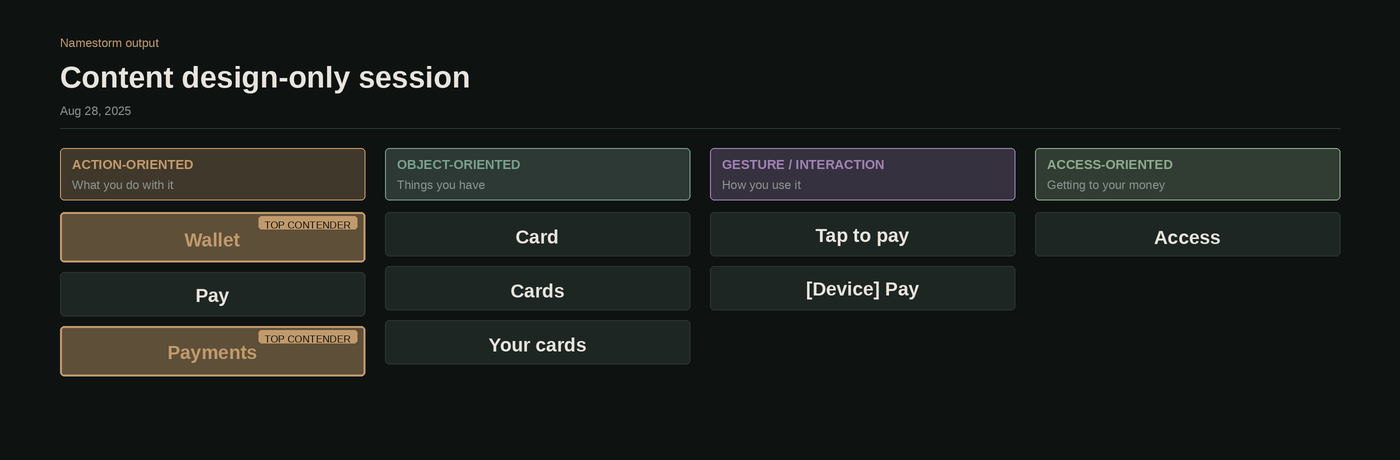
The content design-only session generated nine names that naturally grouped into four categories. This taxonomy became the framework for the cross-functional session — instead of presenting a list of names, I presented a structured landscape of options, each with a different strategic tradeoff.
The categories: action-oriented (what you do), object-oriented (things you have), gesture/interaction-inspired, and access-oriented. Top contenders from the content designer session were Wallet (future-proof, intuitive, industry-standard) and Payments (clear at launch, precedent from India pilot).
Ten participants.
One shared brief.
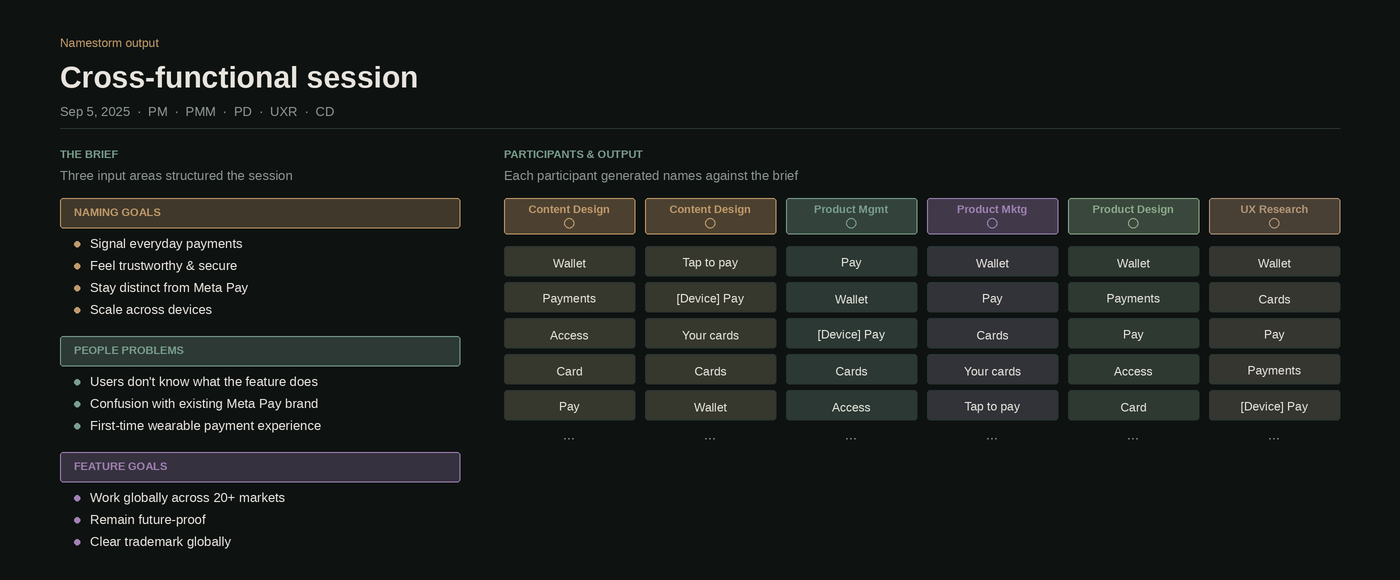
The cross-functional namestorm brought in PM, product marketing, product design, and UX research alongside the content design team. I structured the session around the naming goals, people problems, and feature goals — so the group was generating names against real constraints, not just brainstorming in a vacuum.
Eight criteria.
One recommendation.
I authored the naming brief — the single source of truth for all cross-functional teams involved. It wasn't just a list of options. It mapped every candidate name against eight product-specific criteria, so the recommendation was defensible at every level of review.
The brief traveled through Legal, Trademark, product marketing, localization, UX research, and executive review. Zero revisions after exec sign-off.
- Signal everyday payments
- Feel trustworthy and secure
- Be familiar and intuitive
- Stay distinct from Meta Pay
- Scale across devices
- Encompass multiple payment models
- Work globally
- Remain future-proof
One name for most markets.
A different one for India.
The recommended name — Wallet — cleared trademark and localization in every target market. But India was a different story. Regulatory feedback from NCPI (India's National Payments Corporation) created a specific constraint: the name "Payments" was the preferred term for the Indian market, where the regulatory environment around payment branding is distinct.
This wasn't a failure of the naming process — it was the naming process working correctly. By running localization and regulatory checks early, we identified the market-specific exception before it became a launch blocker. The brief was updated to reflect both the global recommendation (Wallet) and the India exception (Payments), with a clear rationale for each.
Industry-standard. Intuitive. Future-proof. Clears trademark globally.
NCPI regulatory preference. Precedent from India pilot. Clear at launch.
Four names.
Tested in real UI.
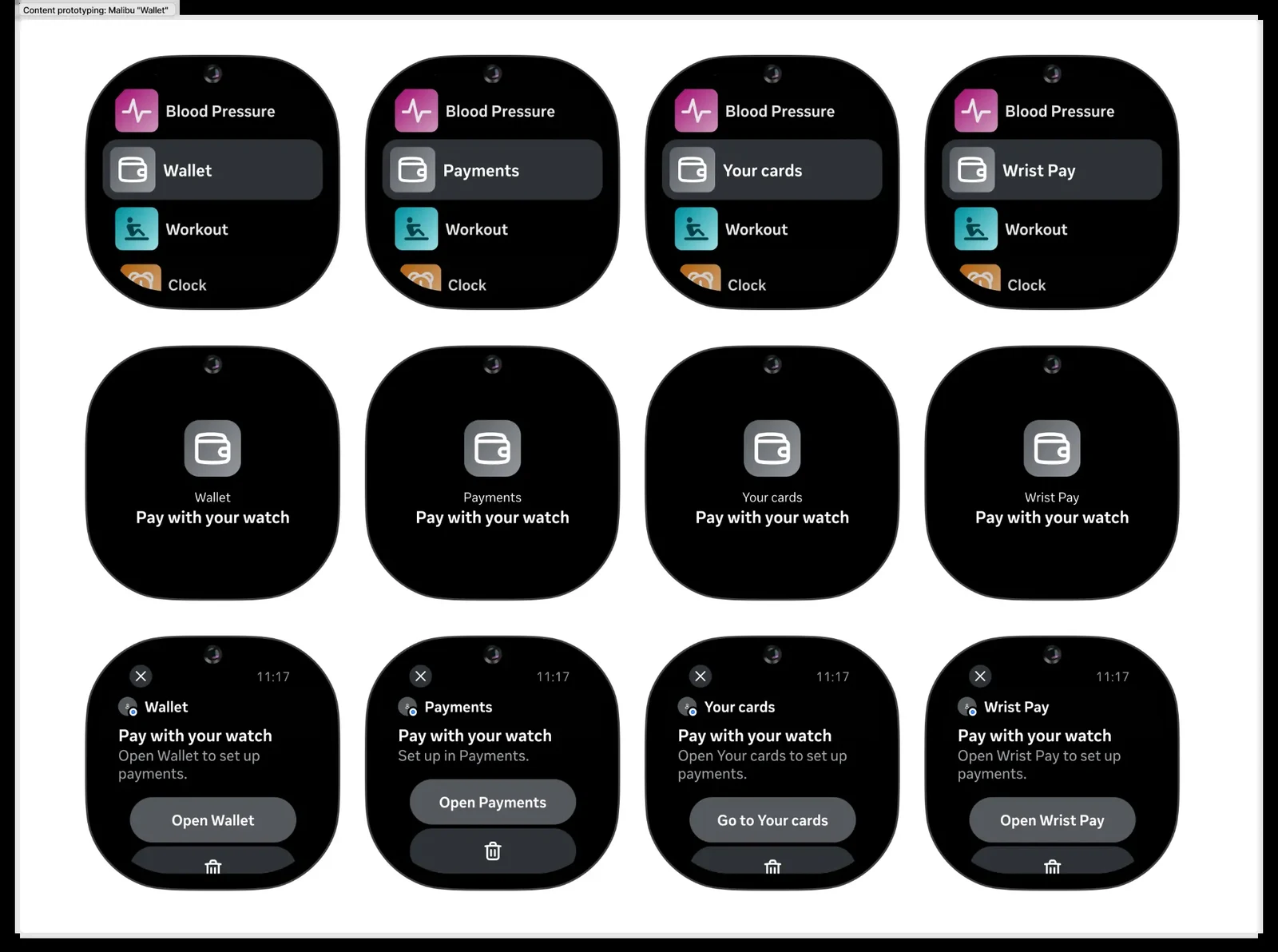
Before the recommendation went to exec review, I stress-tested the top candidates in actual watch UI — showing how each name would appear in the app list, as an app icon label, and in a notification. This made the tradeoffs concrete: "Wrist Pay" felt clunky at small sizes; "Your cards" required a possessive that created IA problems downstream; "Payments" read as transactional rather than a place you go. "Wallet" held up across every surface.
Enter the passcode to continue.
Incorrect passcode. Try again.
From name to
implementation.
Once "Wallet" was confirmed, I worked with product design and engineering to apply the name consistently across all companion app surfaces — the add card flow, the card management hub, and the transaction history. The implementation covered two entry points (from device setting and from global setting), the card provisioning flow, and the Wallet hub with payment apps and recent transactions.
A framework that
scales to future devices.
A stakeholder-aligned decision document that mapped each naming option against every constraint — so the recommendation was defensible, not just preferred.
A unified terminology framework for payments across multiple device types and international markets — not a one-off decision but a system for future devices.
Localization-ready naming conventions that accounted for regulatory differences in India and Brazil — where payment regulations created unique branding constraints.
The name I proposed
was the one that moved forward.
The name secured executive approval and survived every review without revision. It met aggressive deadlines despite the late start. And the framework scales to future devices — it's not a one-off decision but a system.
My manager described this as demonstrating the ability to "excel at navigating high-stakes ambiguity involving legal and international constraints." That's the work.
What I'd do differently: start earlier. The naming work came late in the product cycle, which compressed the timeline and created unnecessary pressure. If you can see a decision that needs to be made six months from now, start the conversation now.
"Ashlee drafted a compelling POV for the naming strategy and settings structure, which helped us understand constraints and feedback from XFNs. It was great to see her leadership and willingness to drive a complex problem."
— Product design peer