Defining how
AI writes
I was fixing the same mistakes in Figma over and over. Answering the same standards questions on repeat. Running office hours that spent too much time on setup and not enough on the hard stuff. So I built tools to solve all three — before anyone asked me to. This is what it looks like when a content designer decides AI is their problem to solve.
The same mistakes.
Over and over.
As the sole content designer on a wrist wearable with 10+ PMs and multiple feature teams, I was a bottleneck. Not because I was slow — because the same foundational issues kept coming back. am/pm instead of AM/PM. Date formats that didn't match standards. Terminology that had been decided and documented but not found. Questions I'd answered in office hours three weeks ago.
I could keep answering the same questions. Or I could build something that answered them for me.
At the same time, the industry was asking whether AI would replace content designers. I wasn't worried about that question. I was more interested in a different one: who's going to define how AI writes?
A self-serve tool that
catches mistakes before they reach me.
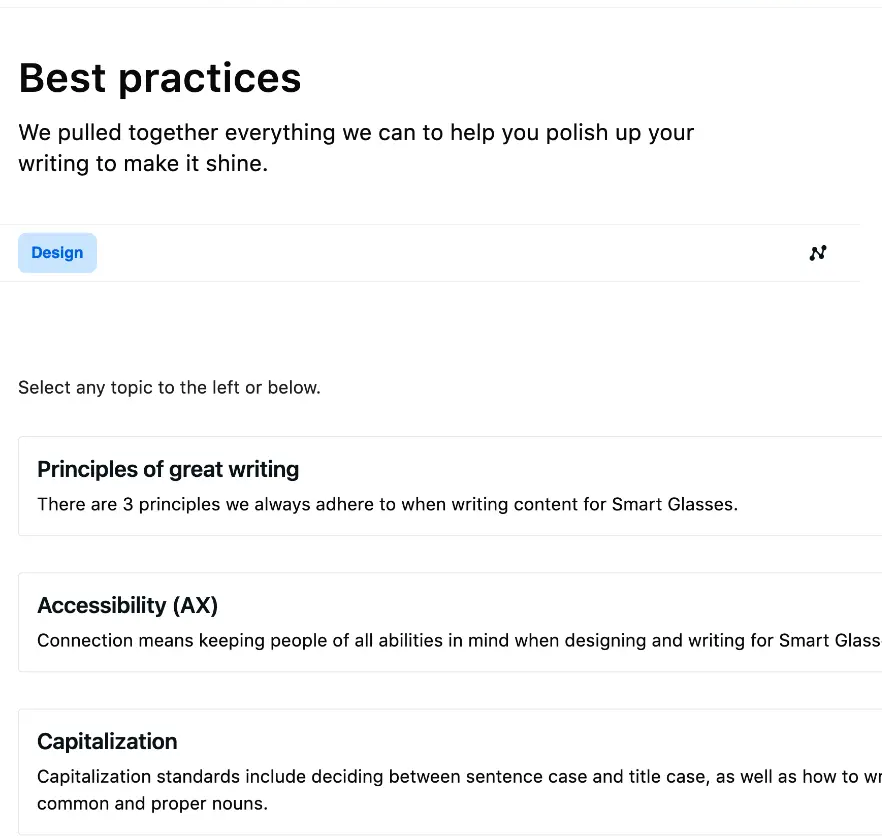
Engineers and PMs were writing Figma copy without content design review — which is fine, until it isn't. The same issues kept surfacing: wrong time format, wrong device name, passive voice in errors, directional language that breaks screen readers. All things that were documented in the standards. All things that shouldn't need a content designer to catch.
I built the Wrist Wearable Content Checker: a prompt-based audit tool that anyone could run before requesting content design review. You paste your UI copy, specify the surface type, and the agent returns PASS, FLAG, or ESCALATE verdicts — with the rule violated, the issue, and a suggested fix. Severity-tiered. Grouped by HIGH, MEDIUM, LOW.
The escalation path was intentional: if the checker says ESCALATE, it found a new pattern not covered by existing standards. That's a signal to me, not a blocker for the team.
An agent that knows
everything I know.
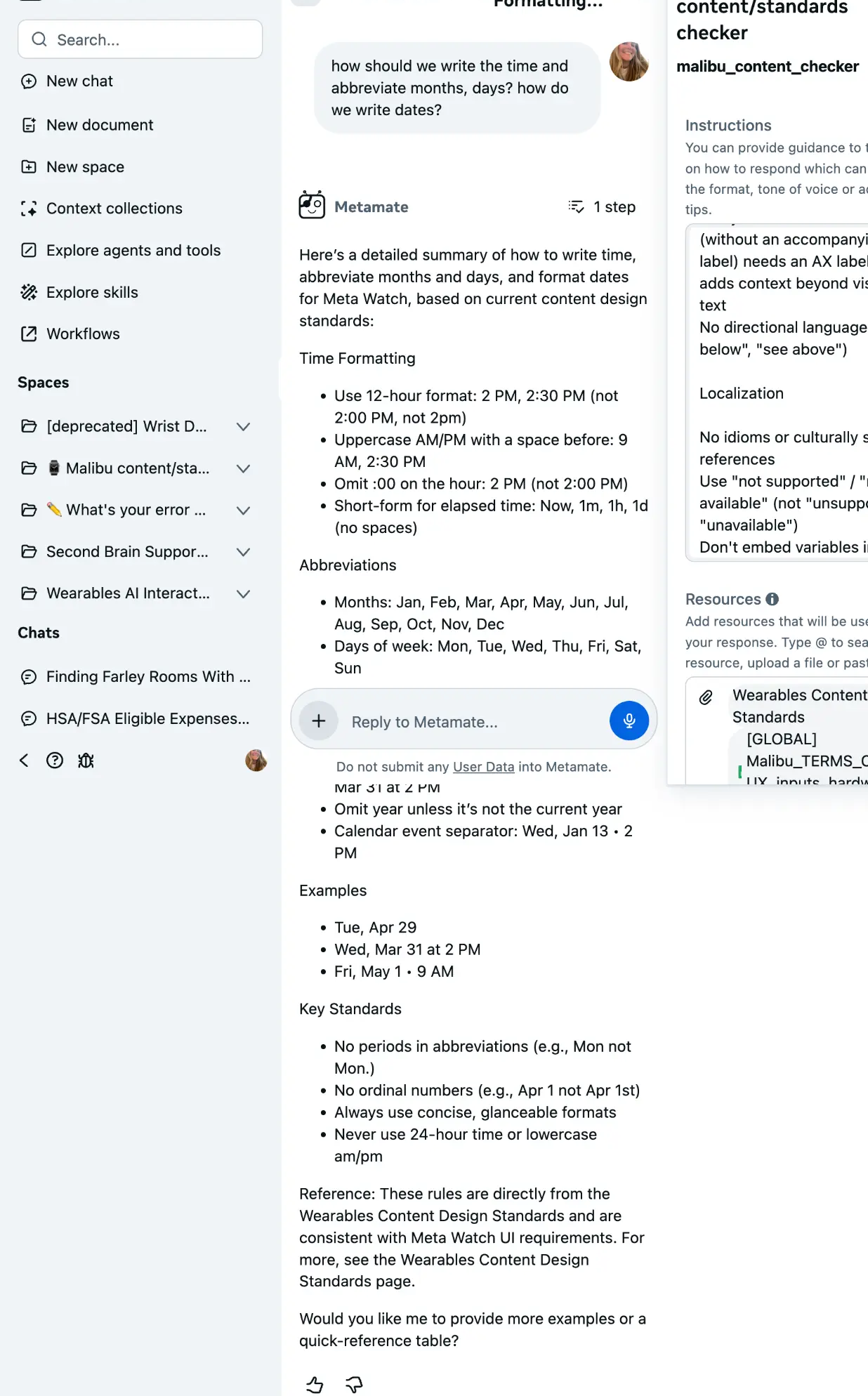
The content checker was for catching issues in existing UI copy. But there was a second, related problem: people kept asking me the same standards questions. "How should we write time and date?" "What's the right device name on this surface?" "Can we use contractions in error messages?"
I built a custom Metamate agent — Meta's internal AI platform — trained on the Wearables Content Design Standards, the wrist wearable terminology glossary, and error patterns. The agent could answer standards questions, generate first-draft UI copy, and flag potential issues. It was connected directly to the standards documents, so answers were grounded in the actual governance, not in the model's general knowledge.
The result: a standards resource that was available 24/7, answered in seconds, and never gave a different answer depending on who asked.
Office hours that
actually scale.
content design office hours are high-value but high-overhead. Too much time spent on context-building. Too many repeat questions. Too much live time spent on baseline hygiene instead of the hard judgment calls that actually need a human.
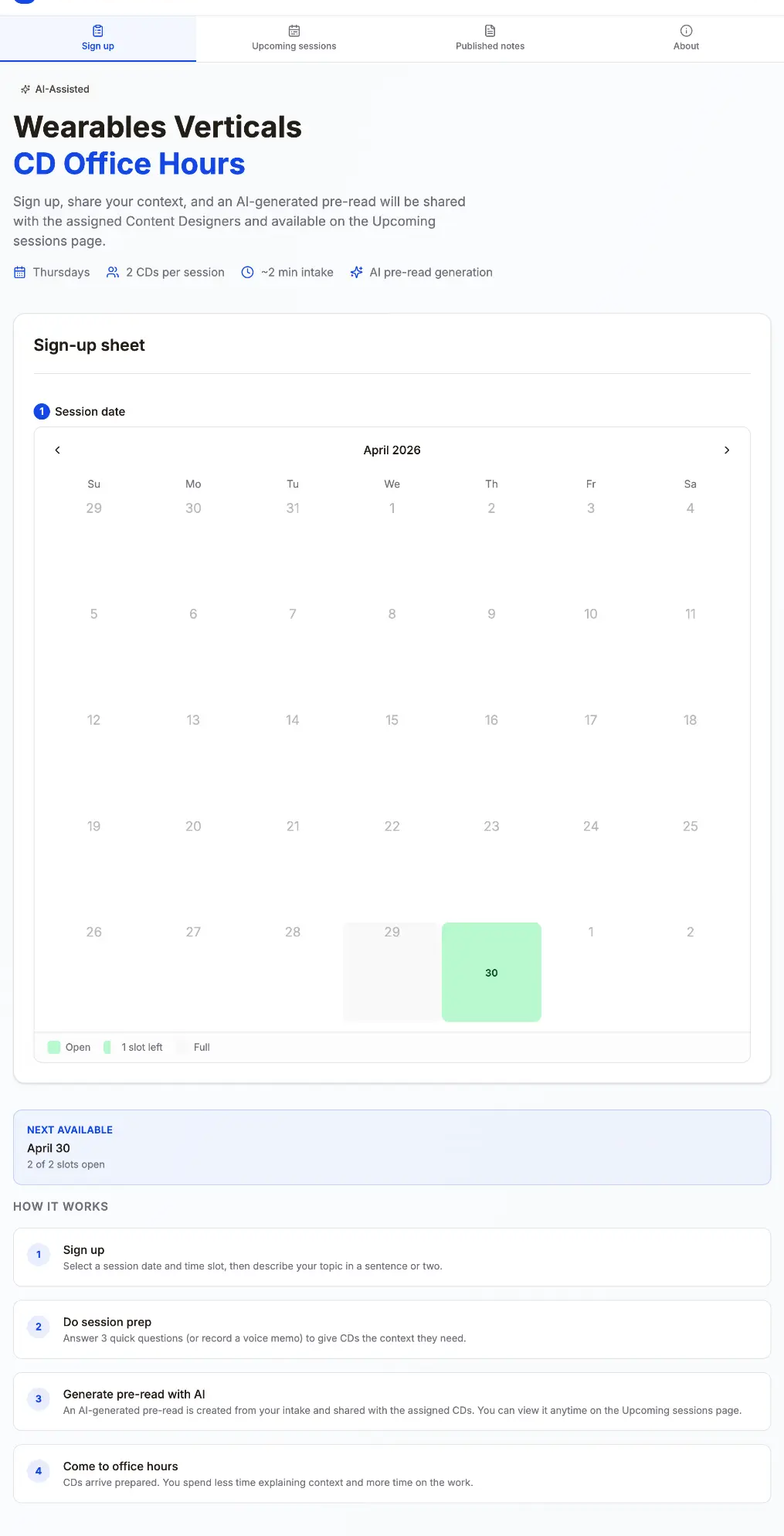
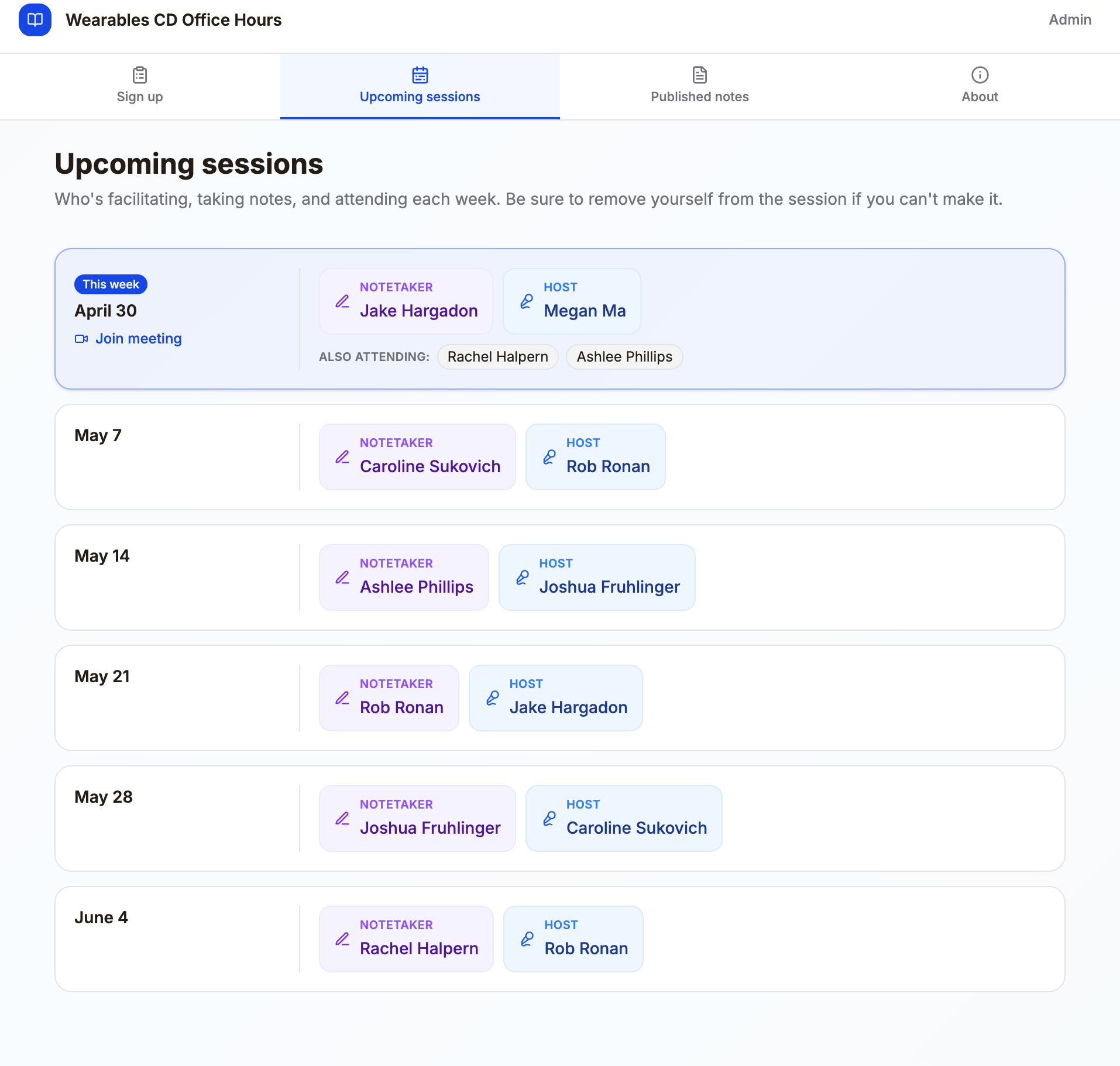
I designed an AI-assisted office hours workflow — and built the tool to run it. The system has three moments: an AI-generated pre-read brief before each session (so content designers show up with context, not cold), AI-structured notes and pattern capture after each session (so institutional knowledge doesn't evaporate), and a feedback loop to identify where standards need updating.
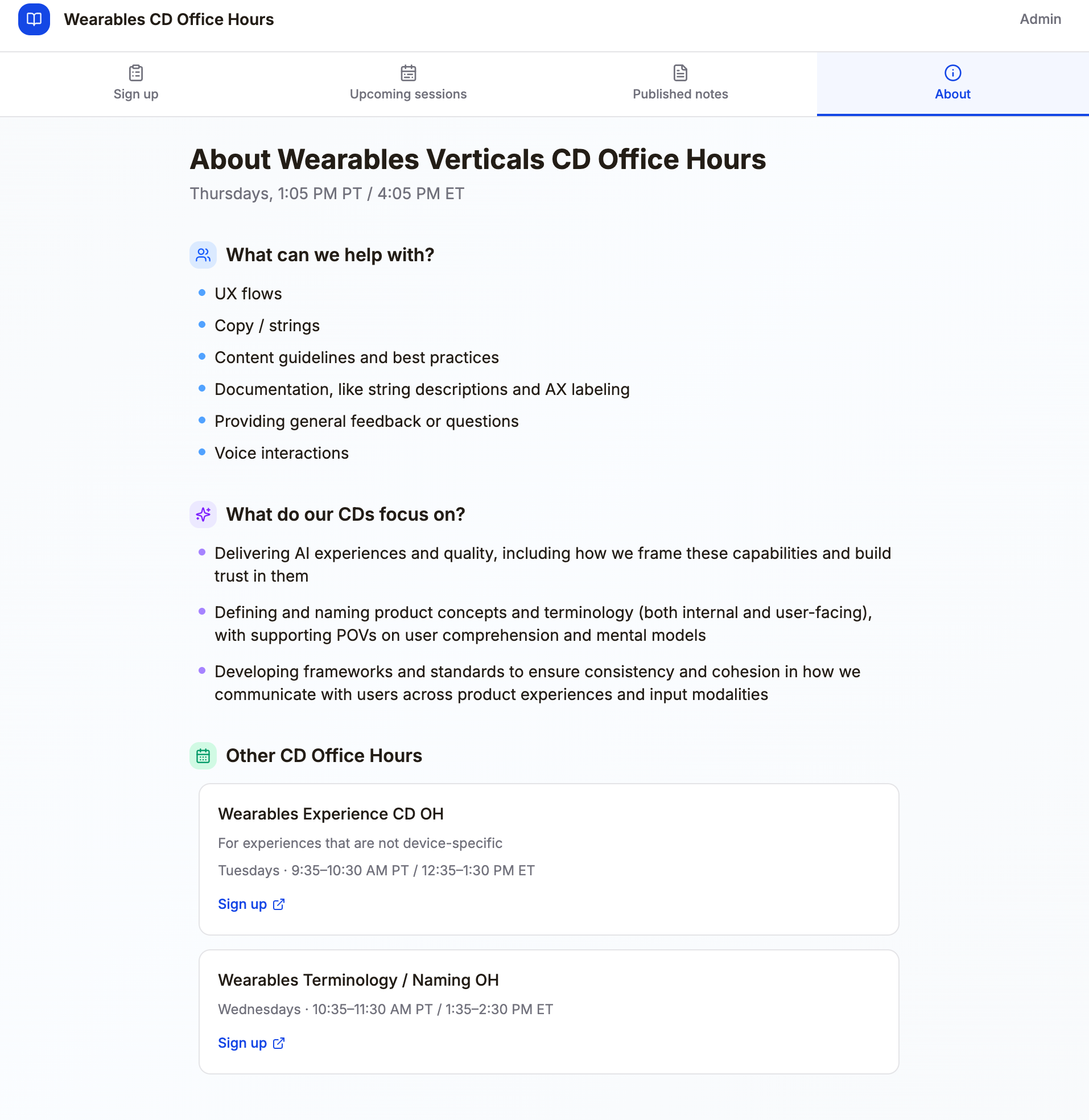
I built the tool itself using Manus — a website that handles sign-ups, intake forms, pre-read generation, and session management. We're piloting it now. The feedback questions are already written. If AI isn't making it better, we stop using it.
Not "AI is coming."
AI is here. I went first.
The companies cutting content designers because of AI are making a category error. They're confusing "AI can generate text" with "AI has content judgment." It doesn't. AI can produce UI copy at scale. It cannot decide which UI copy are appropriate for a user who just got a health alert, or how to communicate uncertainty without eroding trust, or when silence is more respectful than a notification.
That judgment is what content designers bring. My job isn't to compete with AI — it's to be the person who decides how AI writes, what it says, and when it should say nothing at all.
The same instinct that led me to build the accessibility practice before EAA was a concern led me to build these tools before AI-first products were on the roadmap. I don't wait for the problem to be assigned. I see it coming and I build something.