Building an accessibility
practice from the ground up
Meta's wearables org didn't have an accessibility problem. It had an accessibility vacuum. I became the Content Design Accessibility Lead — not because someone posted the role, but because I saw the gap and filled it. Four years later, the Accessibility Hub I built is still the canonical reference for the org.
Building Accessibility from Nothing
Not assigned. Self-initiated. From a lightning talk to the canonical org reference.
Not a problem.
A vacuum.
When I started looking at accessibility in Meta's wearables org, the issue wasn't that people were doing it wrong. It was that most people weren't thinking about it at all. There was no shared framework for what accessible content looked like on a wearable device. No checklist. No owner. No institutional knowledge.
Content designers were shipping copy without knowing whether they met WCAG requirements. Engineers were implementing without accessible labels. PMs were signing off on flows that would fail an EAA audit. Not because anyone was careless — but because no one had built the infrastructure to make accessibility the default.
I wasn't assigned to fix this. I saw it, named it, and decided to own it.
"RL's accessibility hub page is now the canonical source for all information regarding accessibility in RL... Ashlee went above and beyond expectations."
— Erin Leary, PMThe Accessibility Hub — and everything around it
Building an accessibility practice isn't just writing a checklist. It's changing how an org thinks about who their products are for. That required infrastructure at multiple levels — reference materials, education, community, and process.
The document
What a canonical hub
actually looks like
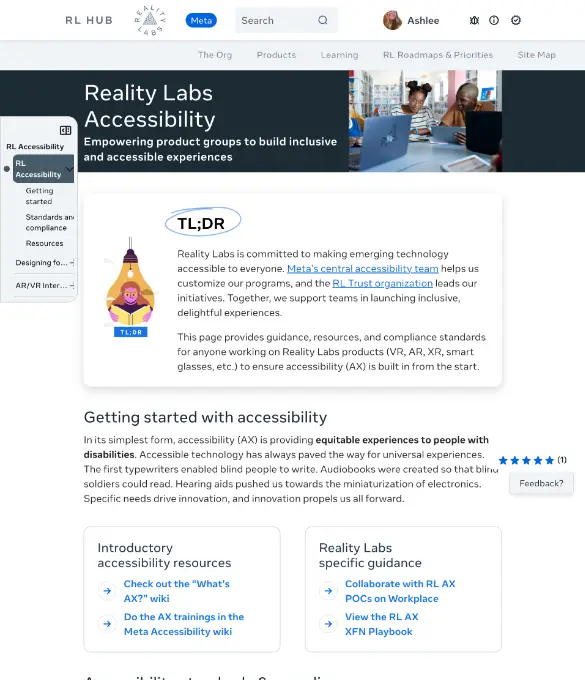
The Accessibility Hub wasn't a document. It was a navigable resource designed to be useful to anyone in the org — a PM finding compliance requirements, a content designer checking a specific WCAG criterion, an engineer understanding what accessible copy looks like in practice. Four years after I built it, it's still the reference.
The tool
An interactive checklist
content designers could actually use
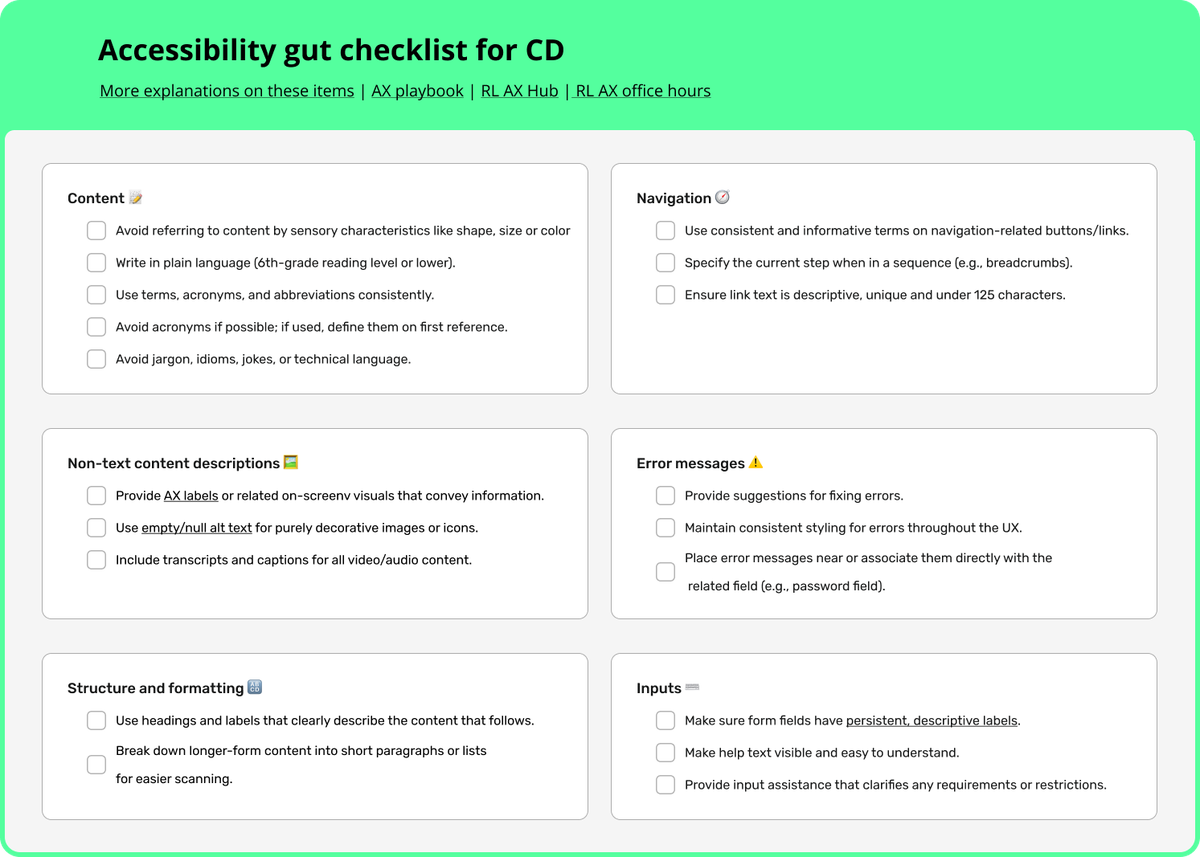
The Accessibility Hub told you what accessibility was. The checklist told you whether your content passed. I built this interactive Figma prototype so content designers could keep it open as a tab while writing — checking off WCAG criteria in real time, with links to deeper guidance for anything unclear. It covers content, navigation, non-text descriptions, error messages, structure, and inputs.
Built in Figma — internal tool, Meta
80% improvement in content designer confidence
The 80% improvement in content designer confidence for delivering accessible content wasn't a soft metric. It came from a structured survey of content designers before and after the Accessibility Hub launch — measuring how confident they felt making accessibility decisions independently, without needing to escalate.
Before the hub: most content designers reported low confidence in accessibility decisions, particularly around WCAG compliance and wearable-specific patterns. After: the majority reported high confidence and cited the hub and checklist as their primary resources.
The 29 bugs closed and 189 tasks resolved were the operational outcomes — the direct result of having a framework that made accessibility issues identifiable and actionable.
Accessibility isn't a feature.
It's a foundation.
The European Accessibility Act came into force in 2025. Products that don't meet EAA requirements can't be sold in the EU. For a hardware product like a wrist wearable, that's not a compliance checkbox — it's a market access question.
I built the accessibility practice before EAA was a pressing concern. That meant when the compliance timeline became real, the org had a foundation to build on instead of starting from scratch. The Accessibility Hub, the checklist, the working group — all of it was already in place.
I didn't build the accessibility practice because it was assigned to me. I built it because I understood what was coming, and I saw the gap before anyone else named it.
"Ashlee presented a memorable and well-received lightning talk about accessibility and 'learn more' links at Comma-Con, which led to an immediate reconsideration of existing guidance in our standards. Your weekly tips and your part in forming a working group dedicated to accessibility practices across FRL have also established your reputation as a go-to for accessibility best practices in the org."
— Christine Mana, ManagerThe canonical reference, four years later
The Accessibility Hub I built is still the canonical reference for accessibility in Meta's wearables org. It's been updated, expanded, and adopted by teams I've never worked with directly. The checklist is still in use. The working group is still active.
That's the measure of infrastructure that works: it outlasts the person who built it.