The person standing
next to the user
Device with a camera. Most out-of-box experience work focused on the person setting it up. We focused on the person standing next to them. I co-led a Social Acceptability audit that reframed the entire out-of-box experience strategy around both user and bystander trust — and produced a repeatable framework adopted across multiple products.
Most out-of-box experience work asks:
how does the user feel?
We were building a device with a camera — a form factor most people hadn't encountered before. The out-of-box experience was designed to help users set it up, understand its features, and start using it. Standard stuff.
What it didn't address: the people standing next to the user. The bystanders who'd encounter the device without choosing to. The people who'd wonder what it was, what it could do, and whether their privacy was at risk.
Social Acceptability is the framework Meta uses to think through how users and non-users permit new technologies into their lives. Since H2 2021, the Privacy UX research team had been developing this framework for wearables. In H1 2022, I co-led the first pilot application of it to a product's out-of-box experience — specifically, Device 1's Day 0 flow.
Four opportunity areas.
One through-line: trust.
The SA audit identified four distinct opportunity areas in the Device 1's out-of-box experience — each representing a place where the experience could either build or erode trust, for users and bystanders alike.
The out-of-box experience couldn't build trust if users didn't know what the device was for. Without a clear Hero Scenario — is this a health device? a social one? — the flow felt unfocused and the value proposition was unclear. Clarity of purpose is a prerequisite for Social Acceptability.
A significant driver of SA is trust in data handling. The out-of-box experience requested a significant amount of data — social accounts, health permissions, cloud backup — without making it clear what was required vs. optional, or what would and wouldn't be shared. We recommended progressive disclosure, explicit optionality, and leading with the user's sense of control.
Users needed to understand what data the device collected, why, and how it would be used and protected — especially as the device became more complex. We recommended plain language, specific value propositions for each data request, and bold commitments to what data wouldn't be used for.
There is no social blueprint for navigating a camera-equipped wrist device around other people. out-of-box experience was the moment to establish one. We recommended explicit bystander-aware content: social etiquette tips, clear guidelines modeling appropriate use, and explicit language about inappropriate use — not as legal disclaimers, but as genuine user education.
Content as the
trust mechanism.
My role was to translate the SA framework's findings into concrete content recommendations — specific language patterns, disclosure models, and out-of-box experience narrative structures that could actually be implemented by the product team.
The most distinctive contribution was the bystander content strategy. Most content work in out-of-box experience is written for the person holding the device. I helped develop the framing that the device's first impression on bystanders would be shaped by the user's behavior — and that out-of-box experience was the moment to shape that behavior through content.
The note we published — "Applying Social Acceptability and Bystander Privacy to Device 1's out-of-box experience" — became the foundation for a broader Designing for Bystander Playbook, and the framework was applied to multiple subsequent products.
"People's privacy extends beyond users. Since H2 2021, we've been studying how to consider user and bystander privacy needs. Enter: Social Acceptability — a framework to help us think through how we help users and bystanders welcome our novel technologies into their everyday lives."
— From the SA note, co-authored with Chelsea Cormier McSwigginWhat we told
the product team.
Especially photos and health data. Users needed explicit assurance that linking social accounts didn't mean automatic sharing — and that Meta wouldn't use health data for ad targeting.
Identify which out-of-box experience screens are optional and provide a "remind me later" path. Users should be able to get to their "wow moment" without completing every setup task first.
Use out-of-box experience to establish social etiquette for camera use — not as a legal disclaimer, but as genuine modeling of appropriate behavior. Visuals and scenarios over written rules.
The recommendation
shipped as a screen.
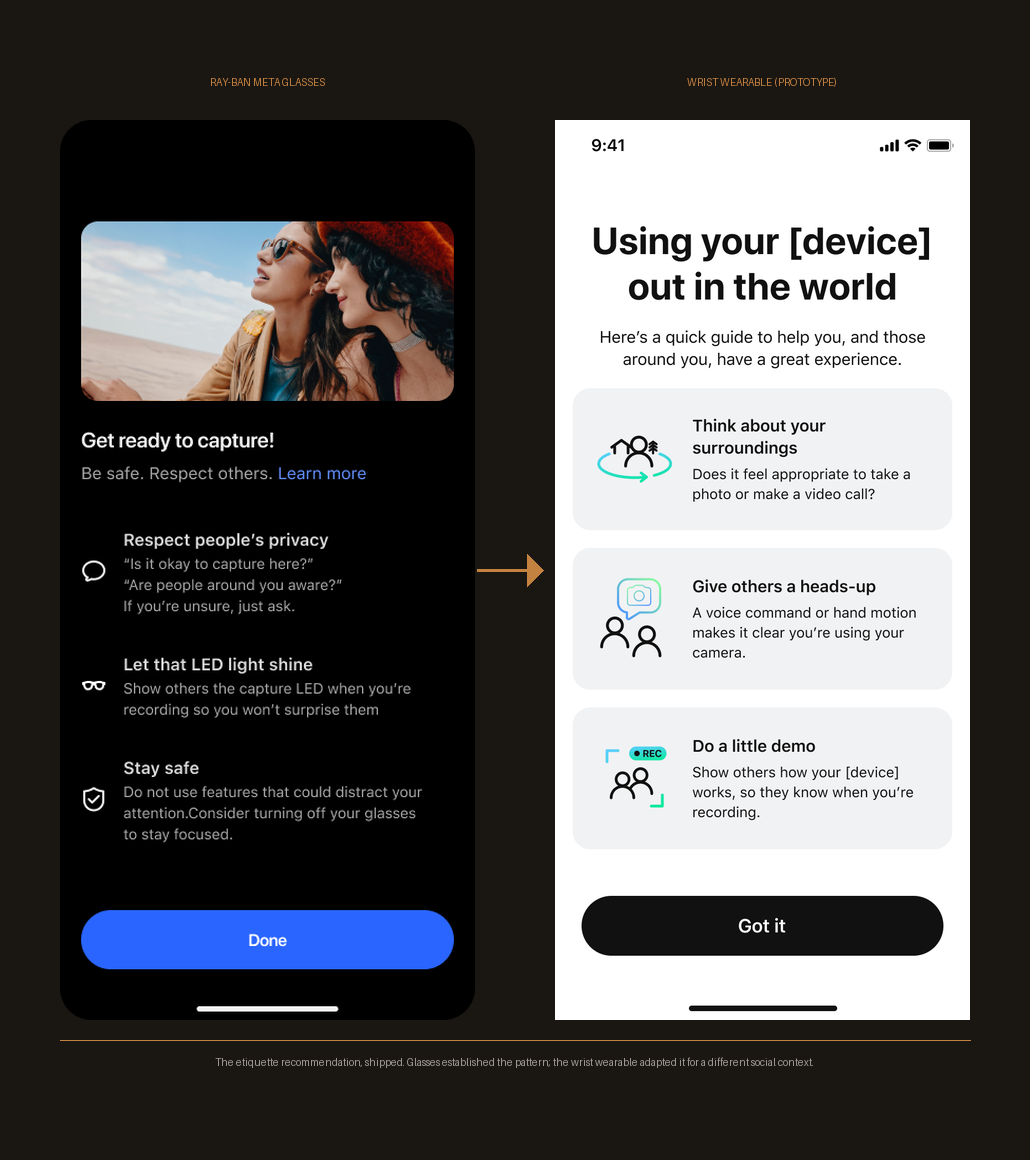
The etiquette recommendation wasn't abstract — it became a real screen in the out-of-box experience. The Ray-Ban Meta glasses established the pattern first: a dedicated OOBE moment that modeled appropriate capture behavior for users before they ever took a photo.
I adapted that pattern for Device 1. The form factor required a different approach: glasses users needed to know about the LED light and asking permission. Watch users needed to think about surroundings, give others a verbal or gestural heads-up, and demonstrate how the device worked — because most bystanders had never seen a camera-equipped watch before.
Same principle, different execution. The content had to match the social context of the device, not just copy the glasses template.
A framework that
outlasted the product.
The SA pilot on Device 1's out-of-box experience produced a toolkit that any product team could apply to their Day 0 flow. The findings directly shaped Device 1's out-of-box experience strategy and informed the CYOA/CHOOBE architecture — the mandatory/optional split that's now standard across all device OOBEs.
The bystander content strategy became the foundation for a broader Designing for Bystander Playbook — a repeatable framework for any product team building devices that interact with people who didn't choose to be part of the experience.
The framework was applied to 3+ products after the initial pilot. The core insight — that trust with bystanders is built through user behavior, and user behavior is shaped by out-of-box experience content — remains relevant for any wearable with capture capabilities.
The hardest part was
making it actionable.
The SA framework is conceptually compelling — of course we should think about bystanders. The hard part was translating "think about bystanders" into specific content decisions a product team could actually implement under deadline pressure.
The lesson: frameworks only travel if they come with concrete recommendations. The SA note worked because it didn't just identify problems — it gave the team specific language patterns, disclosure models, and narrative structures they could use immediately. Abstract principles don't ship. Specific copy does.